Hebrew on Your Invitation: The 5 Words to Know
You don’t need to speak Hebrew to put the right words on your invitation. Here are the 5 essential terms and where to place them.
On this page
Even if most of your invitation is in English, these 5 Hebrew words instantly make it feel more authentic to guests who know the tradition. Here they are, and where to place them.
1. Mazal tov (מזל טוב) — "Good star"
Literally "good star". It's THE word for congratulating any joyous occasion: wedding, Bar/Bat Mitzvah, birth. Place it prominently in your invitation's closing moment, right before the CTA. For a brit or a pidyon haben, some families prefer "Be'sha'ah tovah" (in a good hour): follow your family's custom or ask your rabbi.
2. Sheva Brachot (שבע ברכות) — "Seven blessings"
The 7 blessings recited under the chuppah, then again over the 7 evenings that follow a wedding. If you’re hosting post-wedding Sheva Brachot dinners, mention the term explicitly — your more traditional guests will instantly understand the format.
3. Aliyah (עליה) — "Going up"
The call to the Torah, central to a Bar/Bat Mitzvah or an Aufruf. Mention the time of the aliyah on your Bar Mitzvah invitation — it's the key moment your synagogue guests don't want to miss.
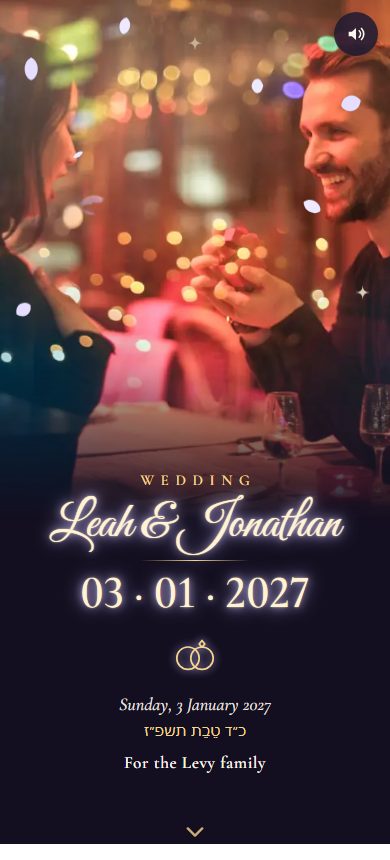
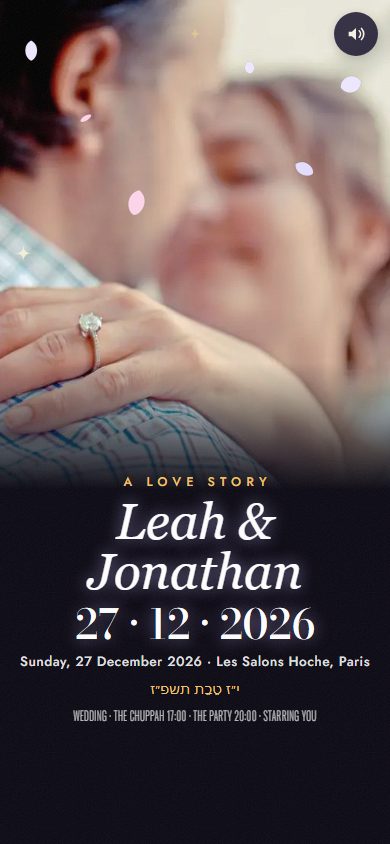
Tov tip: you can choose each household’s language; for Hebrew-reading households, the invitation (buttons, dates, reply form) then appears in Hebrew, right to left, with native Hebrew fonts. The words you type are not translated: write "עליה" directly if you want the Hebrew.
4. Kashrut (כשרות) — "Dietary law"
The level of kashrut for the meal. If your caterer is certified, say so explicitly: "Beit Din certified", "mashgiach on site". Observant guests genuinely care about this — it's a reassuring detail, not a formality.
5. Simcha (שמחה) — "Joy"
The generic term for any joyous celebration. "Dear guest, we would be honored by your presence at our simcha" works for a wedding, a Bar Mitzvah, a Brit. Elegant, traditional, never pretentious.
Two more small words, outside the list: "בס״ד" (be-siyata di-shmaya, "with the help of Heaven"), which some families place at the top of their invitation, and "ben" / "bat" (בן / בת, "son of" / "daughter of"), which connect a Hebrew name to that of a parent, for example "Avraham ben Yosef", "Noa bat Rivka" or "Eliyahu ben Meir".
The trap to avoid
Don't write Hebrew in Latin transliteration everywhere. If you really want the authentic effect, write it in Hebrew script (מזל טוב, שמחה). If your invitation tool doesn't natively support Hebrew, your more traditional guests will notice.
Tov.events shows the invitation in English, French, Hebrew or Spanish, depending on the language you choose for each household (otherwise, the event’s language). Free during the beta.
About — Written by the Tov.events team, who build the tools Jewish families — Sephardic, Ashkenazi, Mizrahi, secular — use for their simchas.
What’s next?
One invitation per household, sent on WhatsApp.
In 4 languages, with the Hebrew date and the replies followed live.
Related reading
- Culture
Jewish Wedding: How to Manage Guests Coming From Israel
Flights, lodging, language, kashrut, Shabbat constraints — the complete checklist for diaspora weddings.
- Guide
Jewish Wedding: The 12-Month Checklist
52 weeks of retro-planning, month by month. So nothing gets missed — from booking the synagogue to the last RSVP reminder.