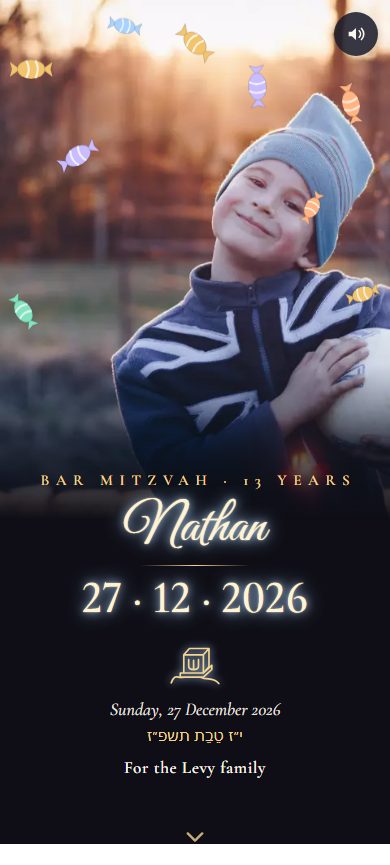
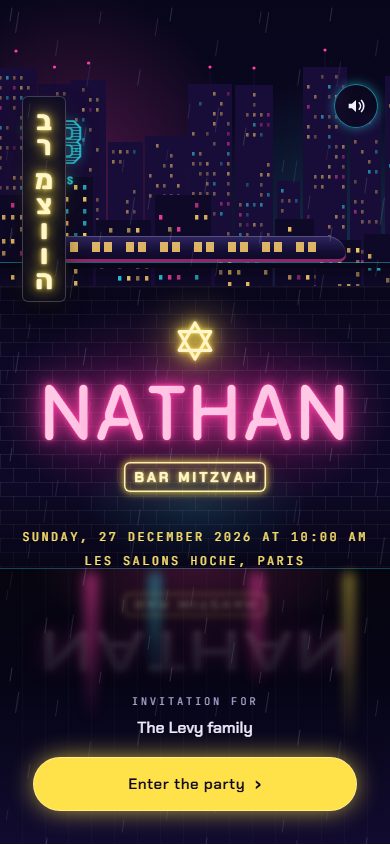
The Bar Mitzvah Parashah: How to Showcase It
His Parashah sets the tone for the whole ceremony. How to weave it into the invitation so guests understand and appreciate it.
On this page
Your son's Bar Mitzvah falls on a given week — and with it, a specific Parashah (weekly Torah portion). It's HIS Parashah for life. On the invitation, this detail deserves to be showcased. Here's how to weave it in elegantly.
1. State the Parashah on the invitation
Recommended format: under the date, in italics or a smaller size, mention "Parashat [Hebrew name of the Parashah] / [English name]." Example: "Parashat Bereshit / Genesis." Tov.events can show the Parashah, calculated from the date — no need to type it in by hand.
2. Add a short quote
A single line from the Parashah, in Hebrew plus an English translation. Example for Parashat Vayetse (Jacob leaves home): "וְהִנֵּה אָנֹכִי עִמָּךְ — And behold, I am with you" (Genesis 28:15). For Lekh Lekha (Abraham leaves his homeland): "וֶהְיֵה בְּרָכָה — And be a blessing" (Genesis 12:2). These quotes give weight to the invitation and impress traditionally observant guests.
Tip: choose a quote that also resonates with your son's personality. A Parashah about movement (Lekh Lekha, Vayetse) for an adventurous son; one about strength (Mishpatim) for a serious son; one about joy (Beshalach) for a creative son.
3. Prepare his drasha around the Parashah
The Bar Mitzvah drasha (speech) should engage with the Parashah. Help him prepare 5-7 minutes: a concrete question he has about the Parashah, his personal take on it, how it connects to his life today. No generic speech — there needs to be a personal angle. That's what will make his grandparents cry.
4. Illustrate the Parashah (visual option)
For couples who love visuals, add a subtle illustration linked to the Parashah on the invitation. Examples:
- Parashat Noach → a rainbow (kept understated)
- Parashat Vayetse → stars (Jacob dreams of a ladder to heaven)
- Parashat Beshalach → waves (the crossing of the Red Sea)
- Parashat Mattot-Massei → a tent / a road (the journeys of the Jewish people)
Tov.events offers understated illustrations in its editor — no kitschy clip art.
5. A themed menu (advanced option)
For very invested families, you can go as far as a themed menu. Parashat Eikev (mentions the "seven species" of the Land of Israel) → a cocktail hour of dates, figs, grapes, pomegranates, olives, wheat-based bites. Parashat Toledot (Esau sells his birthright for red lentils) → a spiced lentil starter. It's a detail that traditionally observant guests will notice and appreciate.
6. What to do if the Parashah falls during a special event
Special cases: if the Bar Mitzvah falls during Shabbat HaGadol (the Shabbat before Passover), Shabbat Chazon (before Tisha B'Av), or during Sefirat HaOmer (between Passover and Shavuot, a period of partial mourning) — check with the rabbi whether certain limitations apply (no live music during the Three Weeks, no dancing during the Omer). Mention these constraints on the invitation if they apply.
Tov.events automatically calculates the Parashah from your chosen date. The verse is yours to choose and type.
To announce his Bar Mitzvah with his Parashah showcased, create your invitation on Tov.events — free during the beta, in English, French, Hebrew and Spanish, with the Hebrew date calculated automatically.
About — Written by the Tov.events team, who build the tools Jewish families — Sephardic, Ashkenazi, Mizrahi, secular — use for their simchas.
What’s next?
One invitation per household, sent on WhatsApp.
In 4 languages, with the Hebrew date and the replies followed live.
Related reading
- Tips
10 Color Palettes for a Modern Bar / Bat Mitzvah
Forget multicolor balloons and clip art. 10 editorial palettes that honor the elegance of the moment.
- Guide
Hebrew on Your Invitation: The 5 Words to Know
You don’t need to speak Hebrew to put the right words on your invitation. Here are the 5 essential terms and where to place them.